Turned Away at the Border: When the Border Hits Our Community
A video has been circulating in recent days among people who live leather culture internationally, and it deserves everyone’s attention. It matters not only for the seriousness of what it recounts, but for what it tells us about why clubs like ours exist.
Its protagonist is a well-known figure in the European bootblack community: the current International Ms Bootblack and former Bootblack Europe. On 25 June she landed in Seattle to attend events run by the local leather community and to take part in the Pride celebrations. At passport control she was asked about her work and the purpose of her trip. Her phone and passport were confiscated, and she was taken to secondary screening. A detention of more than twenty-four hours followed: her phone password extracted under an implicit threat, a sworn and video-recorded interrogation, deprivation of sleep, caffeine and nicotine, even of coffee. She slept on a camp cot and had to plead for access to prescribed medication in her luggage. In the end she was refused entry, her ESTA was revoked, and she was put on a flight home, escorted to the aircraft door by two officers, one in front and one behind.
The heaviest consequence came afterwards, when a lawyer told her she was now “technically inadmissible” to the United States. To return she would need a waiver, with processing times estimated at 9 to 12 months and very slim chances of approval before a year or two had passed. In effect, this is a door closed indefinitely on a country that holds a huge share of the history, events and relationships of the worldwide leather community, the very community her title calls her to represent.
Why this story concerns us too
We could read it as an isolated incident, the misadventure of someone we don’t know, in an airport far away. But it isn’t. It is a reminder of how fragile, everywhere in the world, the spaces we take for granted really are: the possibility of travelling to meet each other, of wearing our skin, literally and symbolically, without having to justify ourselves, of claiming an identity without it becoming a risk.
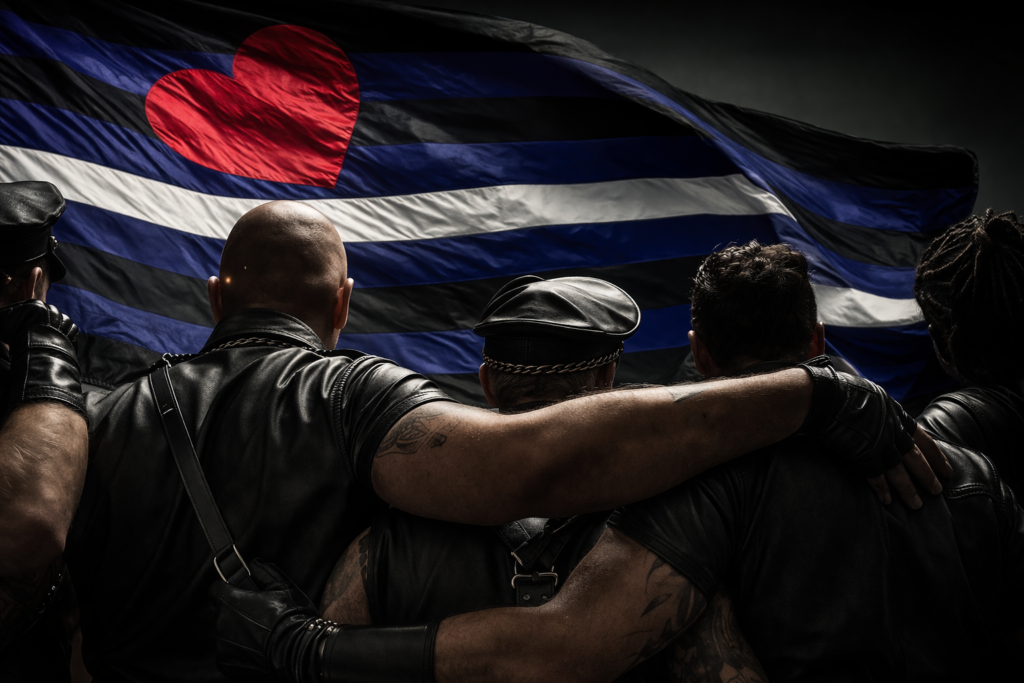
This is where the raison d’être of an association like LCR comes in. We don’t simply organise evenings and events. We build a place that endures, a fixed point that doesn’t depend on a flight, a visa, or the discretion of a border official. The strength of a leather community isn’t measured only in large international events, but in the daily network of people who know each other, support each other, and look for each other when things get complicated, inside and outside national borders.
The testimony closes with a precise appeal: a request to be included in events outside the United States, and the need to still feel an active part of something, despite everything. It is an invitation worth taking up, and not only for her. It is the invitation we extends every day to anyone who recognises themselves, even in part, in this culture: show up, come to our evenings, take part in our meetings, don’t stay on the margins. An association lives on physical presence, on people shaking hands, sharing experiences and recognising each other in a safe setting. The more of us there are, the more solid these spaces remain, even when, elsewhere, doors we thought were guaranteed are being closed.