





Intervista
Behind the image, inside the community
Leather Club Roma · https://www.lcroma.com/en/behind-the-image-inside-the-community/
Interview with Antonello, Secretary of Leather Club Roma, photographer and graphic designer
There are people who enter a community long before they actually cross its threshold. They observe it, recognise its images, follow the people. They picture themselves there, but the first step takes time. For Antonello, Leather Club Roma was for a long time that place: close in his desires, further away in daily life.
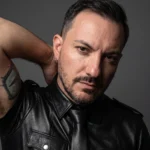
Photographer, graphic designer, retoucher and content creator, Antonello has been the Club’s Secretary since the board renewal of February 2025. Yet he still feels above all like a behind-the-scenes person. With Gius he retraces his fascination with leather, a harness bought in 2009, meeting Chris, friendships and a shoot in which, for once, he handed the camera to someone else.
«I wanted to be one of them.»
Before crossing the threshold
Gius — Where does your relationship with leather imagery begin?
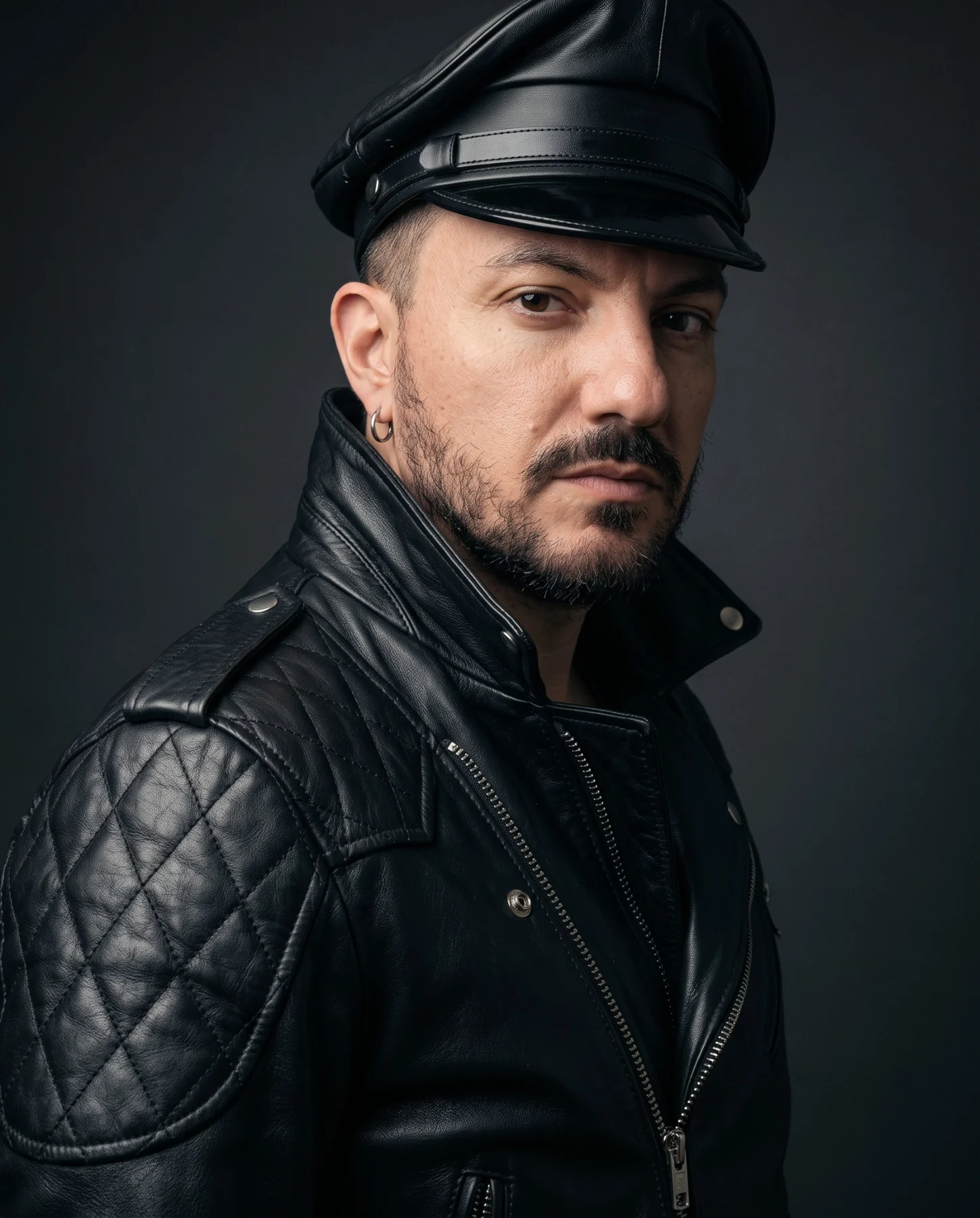
Antonello — With an image, even before a word. As a child I saw on television, in the days of Videomusic Italia, the video of “Relax” by Frankie Goes to Hollywood. I was struck by the atmosphere of the club, the clothes, that very strong presence of leather. I didn’t have the tools to understand everything I was seeing: it was a visual fascination, a world that stayed in my head.
There are images you only truly understand many years later. Back then I couldn’t have explained why. Growing up I recognised something that belonged to me, and I understood why that language had attracted me so much.
But you could wear the biker jacket outside that world too.
Yes, and it’s one of the things I have always loved. The biker jacket belongs to leather, but also to bikers, rock, punk, fashion. It changes cut, colour, model: it can be classic or very fashionable. You can wear it in many contexts without anyone necessarily reading it as a fetish garment.
For me it was a bridge. I wore something I felt was mine without having to explain anything. My first really important jacket was an original Perfecto Schott. I kept it for years, then decided to sell it and pass it on to someone else. I liked the idea that it would go to a person with the same dream and the same desire I had when I bought it.
Leather creases, gets marked, changes with the person who wears it. It doesn’t stay identical to the shop window. And when it passes to someone else it almost keeps living: it carries one story and begins another.

The first concrete approach came in 2009. What do you remember?
I met Stefano and he took me to a second-hand market. There I bought my first harness, handmade. It was something concrete: until then I had mostly watched, desired, imagined. At last I had an object that truly belonged to that world.
Unfortunately I had to sell it again. I found out I have a strong allergy to nickel snap buttons. It wasn’t exactly the follow-up I had expected! It’s a limitation I still carry with me: many accessories have rivets, buckles and metal parts. I have to check the materials, find solutions or give up pieces I like. I would like to express myself more through accessories too, but I have to deal with this.
And yet you didn’t join the Club right away. What held you back?
I wasn’t ready. Wanting something and managing to do it are two different moments. I’m very closed, shy, and the idea of walking alone into a place full of people I didn’t know made me uncomfortable.
I kept following Leather Club Roma for years: the events, the photos, the initiatives, the people, the social media. I looked and thought: “I wanted to be one of them”. I felt close to what I saw, but I stayed on the other side. It wasn’t a lack of interest: I lacked a way to take that first step without feeling completely exposed.
A camera to get in
Then Chris arrives. How does the situation change?
In December 2022 I met Chris and, with a sort of work excuse, I was asked to photograph Mr Rubber during Fetish Pride. Photography gave me the right way in. I had a task, I knew what to do, I could stay behind the lens instead of wondering where to stand or who to talk to.
The camera is also a protection for me. It doesn’t erase the shyness, but it lets me be there. The following month, in January, I became a member. From there friendships, collaborations, professional relationships and an ever stronger involvement began. An environment I had looked at from afar began to have names, voices and people I felt at ease with.
Chris also brought you closer to latex. What do you like about it?
Mostly thanks to him I started to love latex too. Leather remains my origin, the language I’m most attached to, but through Chris and Mr Rubber I discovered another way of feeling and seeing the body.
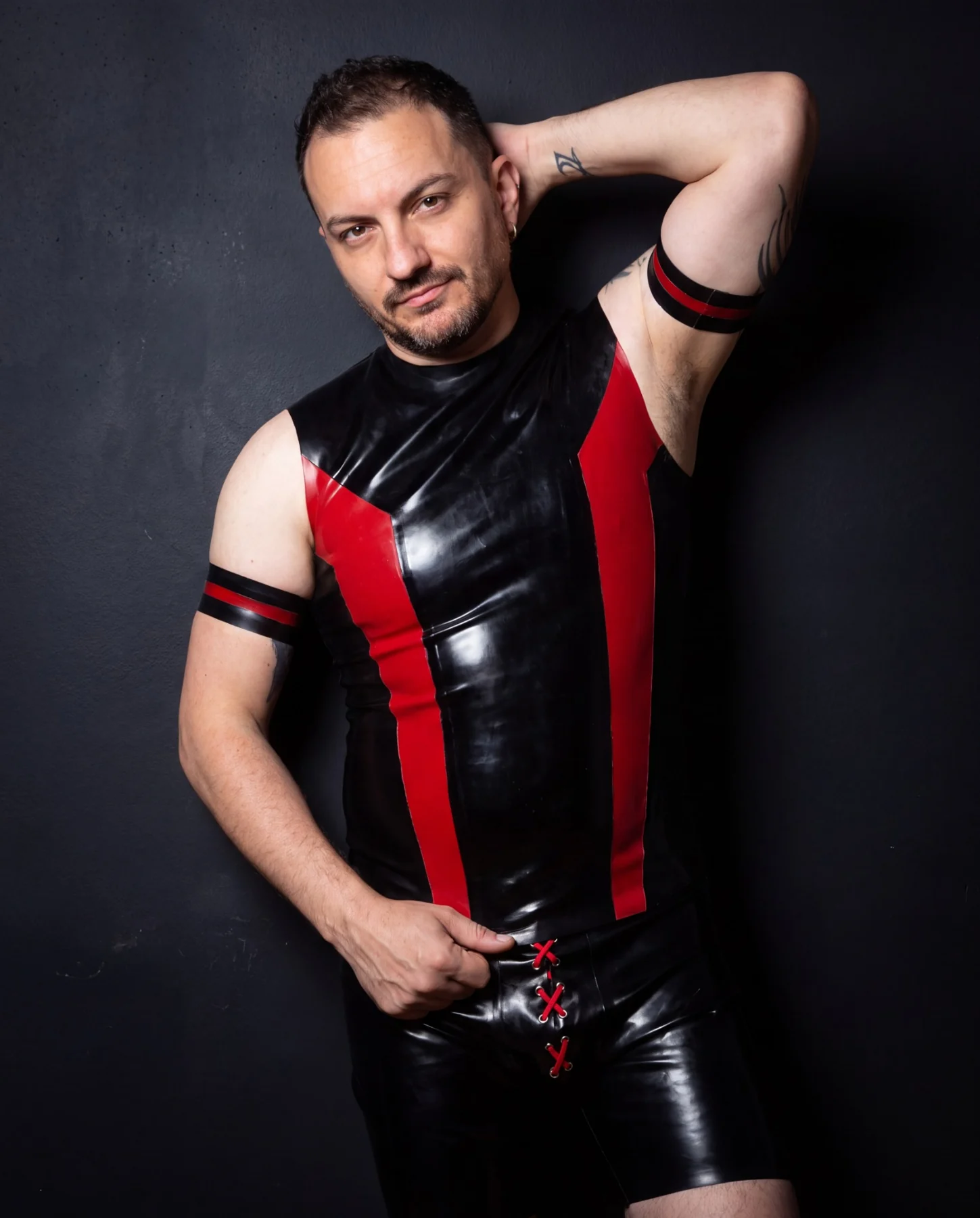
I like how it clings, how it follows the shapes, that second-skin effect. I like the shine, the smell, the sensory side. And as a photographer I’m very drawn to the way it reacts to light: it takes little to change a surface and turn it into a very sharp line.
I still have little latex: shorts and a top, a sort of bodysuit split in two. Let’s say my rubber wardrobe is still too small to declare war on leather! But I like it, and I like continuing to discover it.
When you photograph them, do leather and latex ask different things of you?
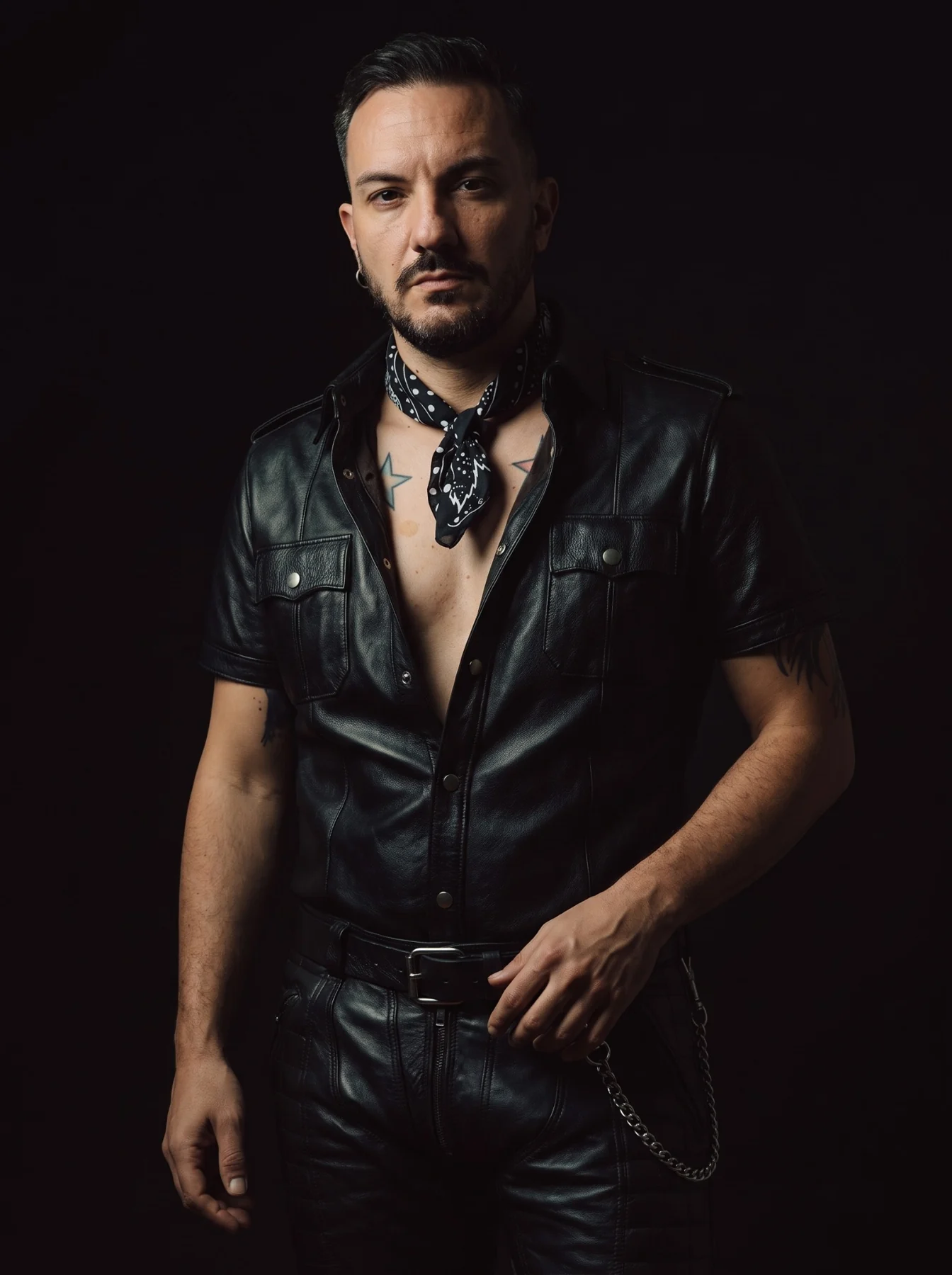
Very much so. Leather has texture, creases, marks. It can be lived-in, it can tell time. The light settles on some points and gets lost in others; I’m interested in that irregularity too.
Latex is shinier, more graphic, sharper. It follows the body very clearly and reflects the light. Sometimes a small change in the lighting changes everything. They are two materials that can be in the same photograph, but they behave differently. For me it’s interesting precisely to listen to them: to understand what they give back, without treating them as if they were interchangeable.
In the meantime we start working together. How did you experience that relationship?
When you started to follow the Club’s communication more closely, we began to talk often. Graphics, photography, images, ideas, projects: there was always something to discuss. I brought what I do in my work and the exchange became very natural.
Then the relationship became human too. You are not just the person I send an image to find out whether it works. A friendship and a complicity were built that matter outside the projects too. And it is one of the reasons why that photographic work we’ll talk about later has a special meaning for me.
From work to the Board, without changing character
What made you decide to run for the Board?
At the time of the renewal I thought I’d throw myself in. It wasn’t a trivial choice, given how I am: running meant exposing myself, asking for trust, accepting that people would look at me in a role other than that of the photographer.
I ran, I was voted in and, after the election, we distributed the roles. The Secretary role was available and I officially put myself forward. So, in February 2025, I became Secretary of Leather Club Roma. I hadn’t stopped being shy. I had decided to take part in a more direct way.
What do you bring to that role, beyond the associative side?
The skills I use every day: photography, graphics, communication, web, archive, image. For me it is natural to put at the Club’s disposal what I know how to do. The Secretary’s job has its responsibilities, but my contribution doesn’t stop at the organisational part.
I keep following the photographs of the nights, the promotional shoots, the images for the posters, the graphics and the website materials. And then the recovery of the archive, of the historical memory. They are different things, but they have a common thread: helping the Club tell its story and preserve what it builds.
Do you feel more at ease behind the scenes?
Yes. It’s my natural place, and I don’t consider it a lesser one. I like seeing a project take shape, fixing an image, finding a solution, making something work. I don’t need to be always at the centre to feel part of what happens.
That doesn’t mean I never want to expose myself. It means I don’t want to become someone I’m not. I can step forward when needed, but I remain a person who observes a lot and who often expresses himself better through work than through a speech in front of everyone.
The shoot, the exhibition and that handshake
How was the shoot from which the exhibition came born?
The initial idea was Stefano Shai’s: I want to say so, because it isn’t a project born from a solitary intuition of mine. The concept was then developed together with the Board and the shoot planned very precisely. There was a running order, the people, the outfits, the scenes and the combinations already decided.
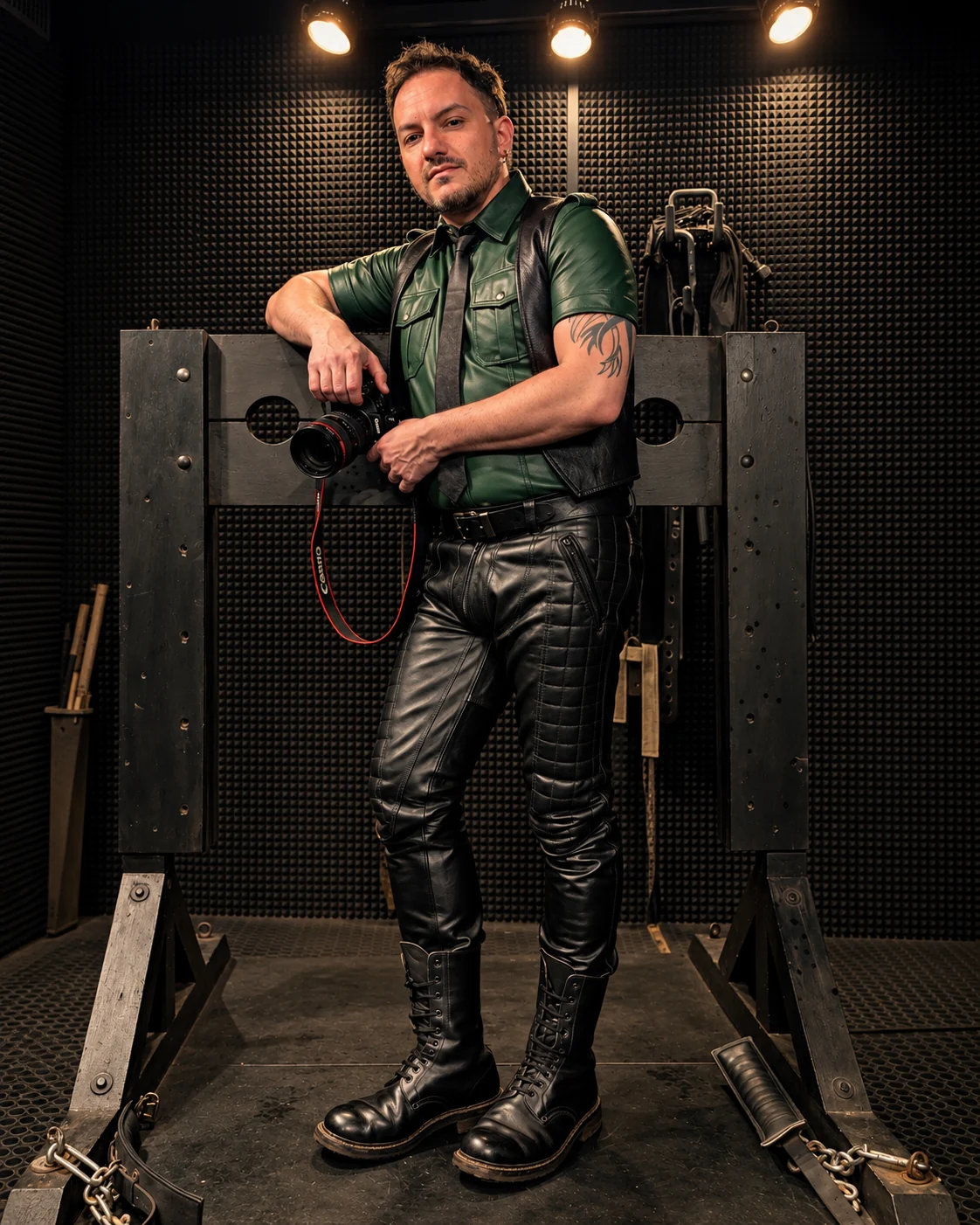
We wanted to tell of family, brotherhood, friendship, closeness. The contrast was the place: a real dungeon, a space normally associated with other activities and dynamics. We chose to use it to show affection, complicity and belonging. I was interested in the place remaining recognisable and, inside that place, the relationships between people emerging.
When did those images become an exhibition?
Later came the possibility of creating an exhibition, with a first occasion linked to an event in Teramo. At the start ten shots were planned. And there the way of looking at the photographs changes: an image designed for communication has to work in a certain context; an exhibited photograph has to be able to live on its own.
Printed, looked at calmly, it has to withstand a longer gaze. The selection becomes different. You are not only looking for the effective shot: you look for the one that contains a relationship, a gesture, a presence. The path then became “Gear Up. Play Proud. Stand Out… Together”, the Club’s exhibition from Teramo to Skyline.
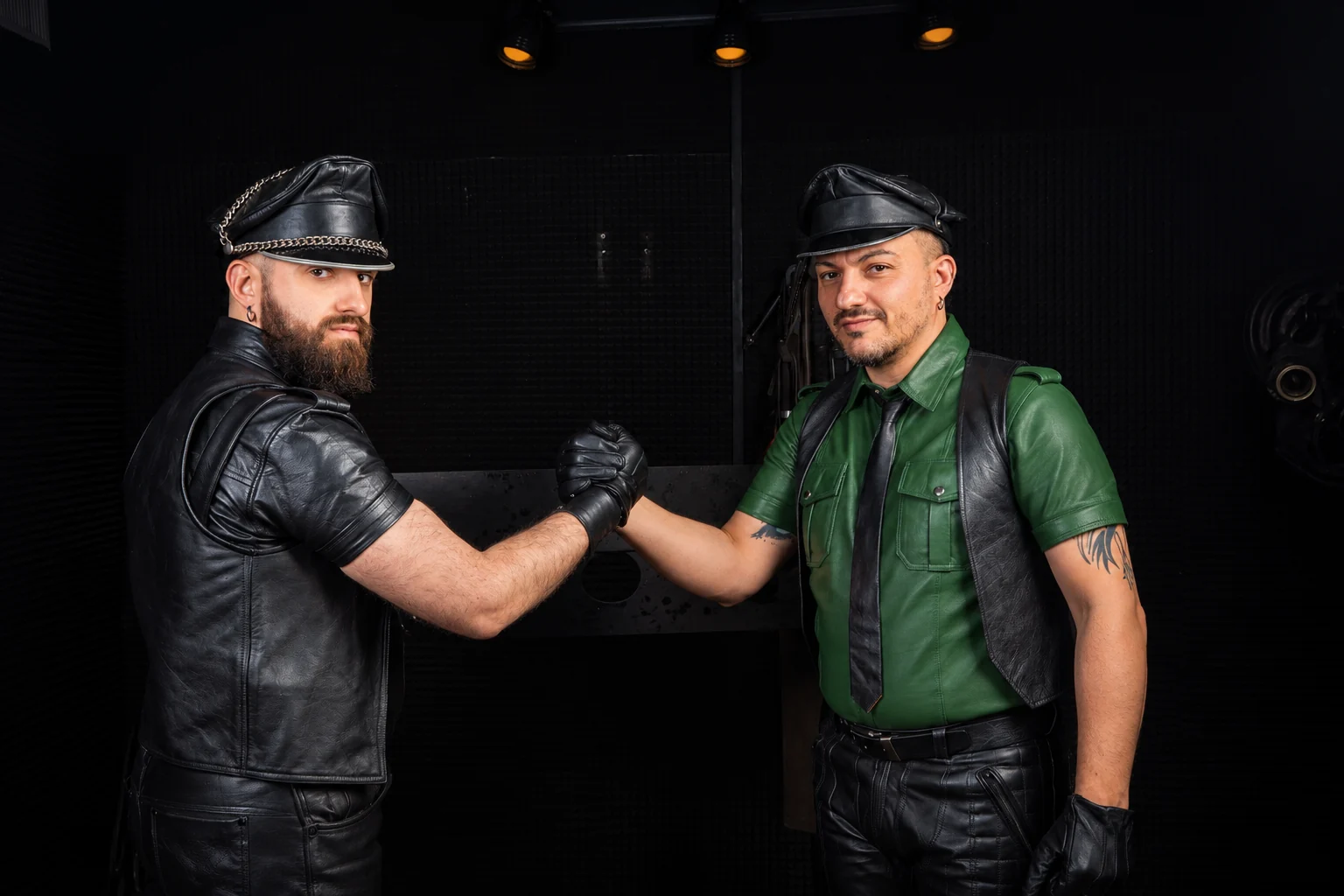
But our handshake wasn’t planned. What happened?
I was the photographer, I wasn’t among the subjects in the running order. At a certain point I realised that I wanted to be inside that project too. Not only behind the camera: right inside the image.
I handed the camera to Simone. I remember he said something like: “Go on Giusè, since you two get on so well, you two do it”. And we improvised that handshake. It wasn’t planned, it wasn’t one of the scenes already set. One hand is mine, the other is yours, and Simone took the shot.
For me it works because we weren’t faking a complicity to get a photograph. That complicity was already there. The image didn’t create it: it gave it a form.
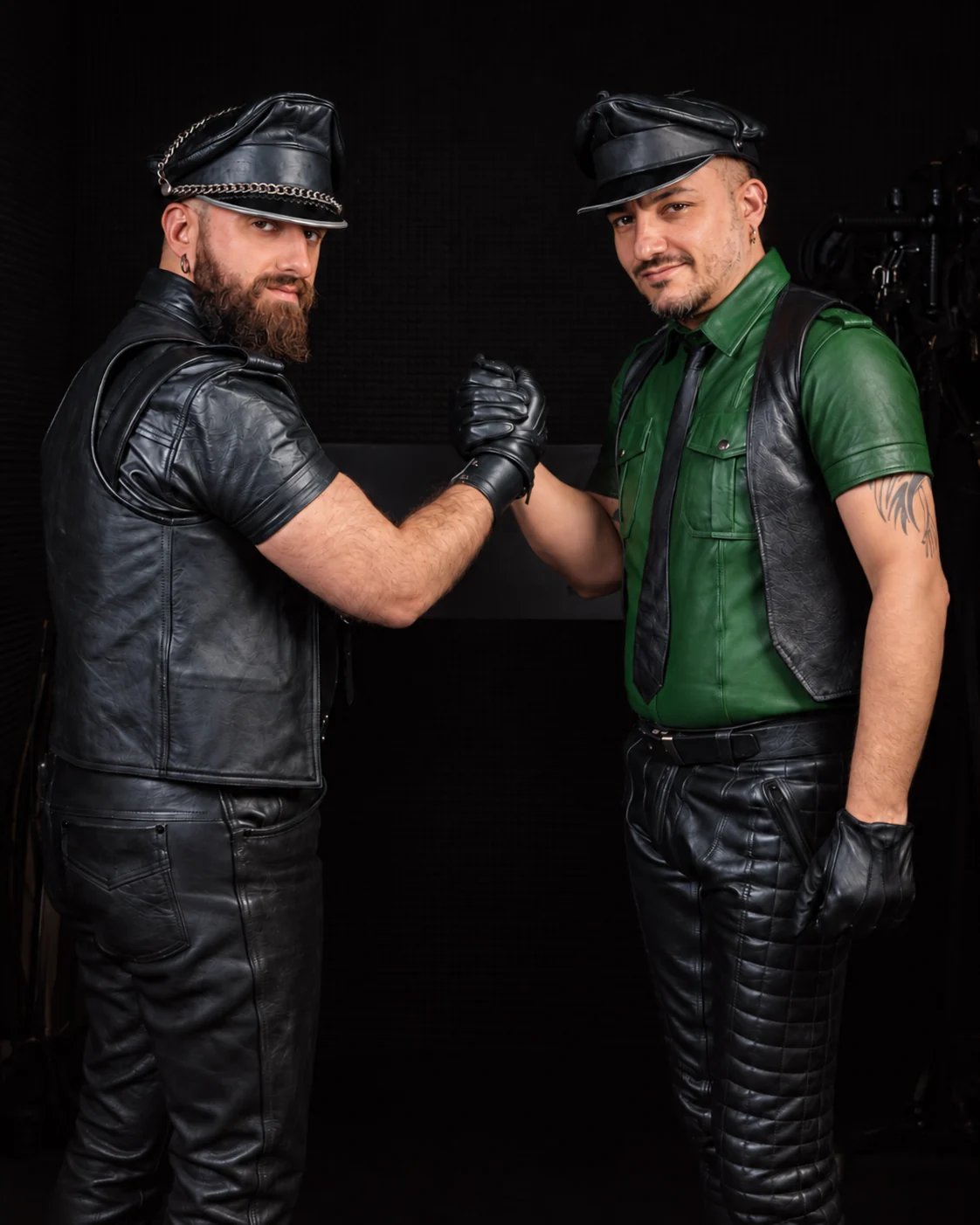
Why do you consider it one of the photographs that tell the Club best?
Because I see my journey in it, but also something that goes beyond me. For years I looked at the Club from the outside thinking I would have liked to be one of them. Then I got in thanks to photography. For a long time I stayed behind the camera. At that moment I passed it to someone else and physically entered the project, through a handshake.
The gesture can tell of friendship and support without having to explain everything. The phrase is “Gear Up, Play Proud, Stand Out… Together”. There is identity, pride, showing yourself. But for me the most important word is Together. It is the one that gives meaning to the others too.
«We weren’t faking a complicity to get a photograph. That complicity was already there.»

Gius’s words on the photograph
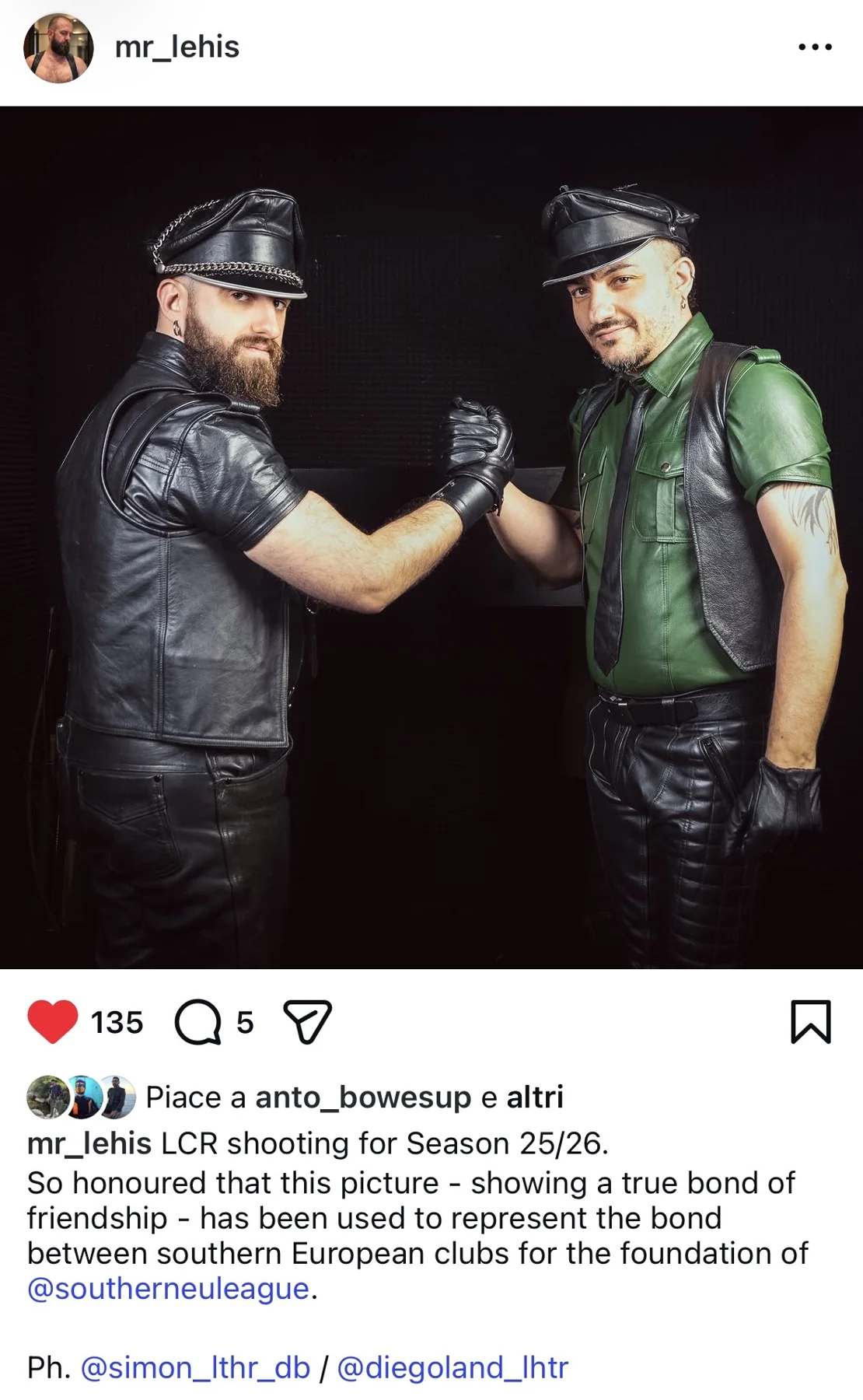
In the Instagram post shared as @mr_lehis, Gius told the meaning of the photo and its use to represent the bond between the clubs of the Southern European League. Here are his words:
«LCR shoot for the 25/26 season. I’m truly honoured that this photograph — showing a genuine bond of friendship — was used to represent the bond between the clubs of Southern Europe on the occasion of the founding of the Southern European League.»
A personal friendship thus becomes an image able to speak of a bigger network too. Read the story of the Southern European League of Fetish Clubs.
See Gius’s original post
Inside the shoot: the backstage
The 2025 backstage video accompanies this story with images of the work behind the scenes.
Exposing yourself, even with anxiety
Did joining the Board change your relationship with the public?
Being in front of an audience makes me anxious. It has always been so, and it still is. I can control it up to a point, but it doesn’t disappear because now I have a role on the Board. There wasn’t a moment when I suddenly became confident or outgoing.
I’m trying to understand when I can take one more step. Without forcing myself to be always available for everything, but also without letting fear become the only criterion. I don’t want to become someone I’m not, but I don’t want anxiety to always decide in my place either.
Is that why you volunteered as a judge at Mr Rubber Italia?
Yes. For the edition Mr Rubber Italia 2026 in Padua I volunteered. I wanted to challenge that difficulty. Going up on stage was a very big effort for me, with strong anxiety. I don’t tell it as something that, once decided, became easy.
The anxiety didn’t magically disappear when I went up. But I managed to do what I had to do. Not because I had stopped being afraid, but because I had decided that at least that time fear wouldn’t choose for me. It’s a small difference to tell, but for me it matters a lot.
When you are the one photographing others, what are you looking for?
A good fetish photograph isn’t simply a person dressed in leather in front of the camera. It has to tell something. I’m interested in the body, the posture, the light, the texture of the materials, the personality, the complicity when there are several people.
I’m not necessarily looking for perfect bodies. I’m interested in the moment when a person manages to feel fully themselves in front of the lens. Sometimes you recognise it from a shoulder that relaxes, a less controlled gesture, a look. My job is also to create the conditions so that person doesn’t have to act out an image that doesn’t belong to them.
Preserving history, leaving a door open
Today you are also working a lot on the Club’s memory. Why?
Leather Club Roma has existed since 1999. There are photographs, articles, posters, names, testimonies, events and Boards at risk of being lost. The internet gives the illusion that everything stays forever, but it isn’t true. Websites disappear, social media change, links die, hard drives get lost.
And people don’t stay forever to tell the stories. Recovering an image or reconstructing a passage also means preserving its context: who was there, why it was done, what it produced. For me it’s not nostalgia. It’s identity. The Club’s history also helps us understand who we are now.
So the work on the website isn’t only about graphics.
Graphics matter, but they’re not enough. The site has to be simple, modern, useful for those looking for the next appointment. And it also has to preserve more than twenty-five years of history. I would like a person who comes in today to understand that today’s events didn’t appear out of nowhere.
Behind them there are people, Boards, projects, collaborations, mistakes, changes. There are things that worked and things that took attempts. The site can connect all this without becoming a warehouse where no one finds anything. It is also a way of making room for those who came before and for those who will come after.
What is your relationship today with the person who in 2009 was watching the Club from outside?
He would probably never have imagined becoming a Board member. If I had told him, he would have made a strange face. A part of me still feels like that person who observes. I don’t perceive myself as “someone important in the Club”.
I still often stay behind the camera, looking at details, thinking about what can be fixed. The difference is that today I’m on the other side of the door. I don’t have to just imagine belonging: there are relationships, responsibilities and people who make me feel part of this community.
What would you like someone who looks at LCR on social media, as you did, to think?
“I’d like to be one of them.” But I’d also like them to know that they don’t have to be already self-confident, know everybody or have the perfect outfit. There is no need to present yourself as the most outgoing person in the room.
You can be shy. You can observe, take your time and find your way in. Mine was a camera. For someone else it will be a friendship, an event, a conversation. There is no single way of being part of this community, and I would like that to be felt from the outside too.
Is there anyone you want to thank?
Gius and Chris, first of all, for the fundamental role they had in my journey. Then Simone, Stefano, Paolo and the whole Board: also for their patience when I mess something up, set off with a thousand ideas or fixate on a detail that, at that moment, seems to me the most important thing in the world.
And Fabio, for his hugs and his worries when he sees me with my head in another dimension and thinks: “Where has this one gone now?”. It makes me smile, but it’s also a way of caring for me.
Finally all the members who supported me, trusted me, had themselves photographed, took part in the shoots and backed projects and ideas. If today I can tell this story it’s because, at some point, someone made room for me inside their own.