










ABOUT US

MORE THAN
A CLUB.

Since 1999, Leather Club Roma has built spaces for freedom, belonging and visibility within leather, fetish and kinky culture. Events, relationships, culture, memory and participation are all part of the same journey.

READ THE LCR STATUTE · PDF IN ITALIAN ↗

OUR DNA

WHAT
WE DO

More than a club: a living community. From nights out to activism, art and culture.

/01

PARTY

Kinky Roma, Napoli, Multiverse. Gatherings, weekends and nights to enjoy the community and your gear.

Explore the events

/02

CULTURE

Photography, cinema and literature. Guides, exhibitions and programmes that explore our roots and look ahead.

Art and culture

/03

NETWORK

ECMC members, connected with clubs and local groups. An Italian and European network of relationships and projects.

Our network

/04

PRIDE

Activism, participation at Pride and representation of our community’s interests. Visible, together.

Our commitment

Identity · Values · Rights

THE IDEAS THAT
UNITE US.

/01 · VALUES

Our manifesto.

Consent, inclusion and freedom: the principles that give the fetish and kinky community a voice.

Read the manifesto ↗
/02 · RIGHTS

Our voice at Pride.

Fetish and kinky voices in the Roma Pride 2026 political manifesto: an achievement in shared representation.

Explore the achievement ↗
/03 · CULTURE

What does kinky mean?

The origins and meaning of a word that describes a language, a culture and a community.

Explore the meaning ↗


LEGACY

OUR
HISTORY.

Since 1999, we have built spaces for freedom and belonging for the leather and fetish community. Gatherings, Pride, photography, cinema and literature: strong roots from which to keep giving our identities a voice.

DISCOVER OUR HISTORY +

0YEAR FOUNDED
0YEARS OF ACTIVITY
0CITIES IN THE 2026–27 SEASON
EUECMC MEMBERS

25 YEARS OF LEATHER CLUB ROMA

OUR HISTORY
IN MOTION.

A journey through twenty-five years of gatherings, culture, pride and community.


ROME, A EUROPEAN MEETING POINT


AGM.
The European community
meets in Rome.

AGM stands for Annual General Meeting: the annual meeting of ECMC clubs, the European Confederation of Motorcycle Clubs.

It is a time to exchange ideas, make decisions and strengthen relationships between clubs. The meeting also brings a weekend of gatherings and community life: Rome’s 2009 and 2019 editions included the election of Mister Leather Europe.

2009AGM Roma 2009


Rome welcomes Europe.


2019ECMC AGM e Mister Leather Europe Roma 2019


Together again.


The next chapter?

Identity · Memory · Representation

FACES OF THE
COMMUNITY.

Two titles, many stories of belonging. Discover the people who have represented Italy’s leather and rubber community through photographs, personal accounts and encounters.

Luciano, Mr Leather Italia 2026

Leather culture

Mr Leatherman
Italia

The titleholders, elections and legacy of the title. A journey through portraits, stories and historical galleries.
EXPLORE THE ARCHIVE ↗

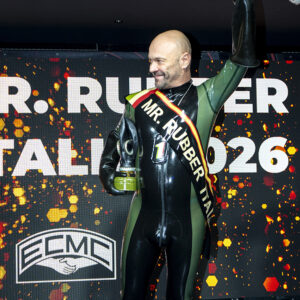
Leonardo Venier, Mr Rubber Italia 2026

Rubber culture

Mr Rubber
Italia

The people, sashes and voices of the rubber scene. Stories and images connecting Italy with the European community.

EXPLORE THE ARCHIVE ↗

ONE COMMUNITY, MANY GROUPS

DIFFERENT
LANGUAGES.

Over the years, LCR has created and welcomed different formats that speak to different audiences, places and sensibilities while sharing the same idea of community.

/01 Leather Club RomaOur shared home and the community’s historical roots.
/02 Kinky RomaA broader, contemporary and inclusive fetish language.
/03 Fetish Pride ItalyThe major annual gathering connecting Rome, Italy and Europe.
/04 MultiverseAn open space for different gear, identities and imagery.
/05 Kinky NapoliRelationships and communities growing beyond the capital.
/06 Kinky PalermoNew connections and new places within the community’s network.

OUR VOICE

WORDS THAT
ENDURE.

YESTERDAY

Different People, Same Rights.

TOGETHER

#StrongerTogether

TODAY

Gear up. Play proud. Stand out.
1999TODAY

Remembering our community

IN MEMORY.

Dodo con cappello e cuore in memoria degli amici della comunità
Claudio Casale

Claudio Casale

One of Leather Club Roma’s first members, a board member and treasurer for many years. His memory, photographs and the scholarship named in his honour.

Remembering Claudio ↗

In memoria di Neri Lauro, Mister Leather Italia 2016

Neri Lauro

Mister Leather Italia 2016, a club board member and friend. The community’s memories, his commitment and a video in his honour.

Remembering Neri ↗
Gennaro, Joy, Mister Rubber Italia 2017

Gennaro “Joy”

Mister Rubber Italia 2017 and a Leather Club Roma activist. Energy, humour and passion: a shared tribute from Italy’s fetish and kinky community.

Remembering Joy ↗

Dodo presenta il Direttivo

THE PEOPLE

BEHIND
THE CLUB.

Board members, collaborators, volunteers, members and participants: LCR exists because people choose to build it together, time and again.

MEET THE BOARD AND COLLABORATORS

MORE THAN A CLUB.
A COMMUNITY.

Get to know us, take part, belong. Your next step starts here.

BECOME A MEMBER

Leather Club Roma · English translation

Statute of Leather Club Roma

English translation for reference of the scanned Statute published on the Leather Club Roma website. This is not a certified translation. The Italian original remains the reference text. Historical legal references are reproduced as they appear in the original.

Establishment, purposes and duration

Article 1 — Establishment and registered office

The association “Leather Club Roma”, hereafter the “Association”, is established pursuant to Article 12 and following of the Italian Civil Code. It follows and complies with the provisions of Law No. 383/2000.

The Association has its registered office at Via Efeso 2/a, 00146 Rome. Secondary offices may be established in Italy and abroad by resolution of the Members’ Assembly.

The Association is a non-profit body, including indirectly. Its internal organisation is based on democracy, equal rights for all members, elected offices and unpaid service in those offices. This Statute is binding on all members.

Article 2 — Principles and purposes

The Association works to build a secular and democratic society in which individual freedoms and human and civil rights are recognised, promoted and guaranteed without discrimination. Leather Club Roma bases its legitimacy on the declaration of human rights, the European Convention and the Treaty of Amsterdam.

The Association is founded on these principles:

  • Respect for and promotion of human and civil rights.
  • Social inclusion for every person and rejection of all discrimination.
  • A healthy relationship between individuals and their social and natural environment.
  • Freedom, equality, solidarity, non-violence and peace, and rejection of all totalitarianism.
  • Internal democracy, members’ participation in the life of the Association and transparent decision-making.

The Association’s purposes are:

  • To promote activities connected with motorcycling, both touring and sport, as a means of members’ physical, mental and moral development, through recreational activities and other physical or non-physical activities that promote knowledge and practice of motorcycling.
  • To promote and practise shared enjoyment of activities in contact with nature, rediscovering the outdoors in all its forms and encouraging knowledge of natural environments, their dynamics, their interconnections and their evolution in relation to human life and behaviour.
  • To encourage motorcyclists to meet and come together nationally and internationally, supporting motorcycle tourism.
  • To promote reasonable, responsible and safe use of motorcycles.
  • To promote and disseminate art and culture by organising or participating in events, competitions, festivals, conferences, debates and exchanges at national and international level.
  • To oppose all forms of prejudice and intolerance.
  • To affirm and protect the civil rights of gay people.
  • To promote the visibility and liveability of gay identity, with particular reference to leather and rubber subcultures.
  • To promote free, informed and responsible sexuality.
  • To encourage sex education and knowledge and dissemination of safer-sex practices.
  • To disseminate information and preventive tools concerning sexually transmitted infections.
  • To combat discrimination against people living with sexually transmitted infections.
  • To participate in organising and promoting Pride and other events concerning homosexuality.
  • To organise recreational and cultural activities nationally and internationally, creating further opportunities for people to come together.
  • To participate in European and international initiatives to advance human and civil rights, particularly those of gay people.
  • To carry out publishing activities through themed publications.

Article 3 — Duration

The Association is established for an unlimited duration.

Members

Article 4 — Admission

All adults who expressly share the Association’s purposes as set out in this Statute may join. Members are the people who took part in establishing the Association and other applicants admitted by the Board.

Article 5 — Termination of membership

Membership ends through death, dissolution, resignation or non-payment. Non-payment is declared by the Board.

Membership also ends if a member no longer accepts the statutory purpose or does not act in accordance with it. Once the Board has established these circumstances, it notifies the member of exclusion by registered letter. The member may appeal within 30 days of receiving the decision. The Assembly, convened within the following 30 days, decides the appeal.

Members who cease to belong to the Association cannot reclaim contributions already paid and have no rights over the Association’s assets.

Article 6 — Members’ rights and duties

Members have the rights to information and oversight established by law and this Statute, to be elected to Association offices, to vote directly or by proxy, and to withdraw from the Association at any time.

Members must comply with this Statute and resolutions of the Association’s bodies, and pay membership fees in the amount and by the deadlines set by the Board.

The Association primarily pursues its institutional purposes through members’ voluntary, freely given and unpaid activities. Members undertake activities decided by the Association’s bodies and assigned to them with their agreement.

Members may be reimbursed for expenses actually incurred in carrying out their activities, within limits established beforehand by the Board.

Governing bodies

Article 7 — Bodies of the Association

The Association’s bodies are the Members’ Assembly, the Board and the President. All Association offices are unpaid and elected, respecting the principle of equal opportunities for everyone.

Members’ Assembly

Article 8 — Meetings and powers of the Assembly

The Assembly comprises all members. The Board, through the President, must convene it at least once each year, by 30 April, to approve the accounts, and whenever necessary.

A meeting may also be requested by at least one third of the members. In this case the President must issue the notice within 15 days of receiving the request, and the Assembly must meet within 30 days of the notice.

Notice must be given at least eight days before the meeting by ordinary post, email, personal delivery or telephone. It must include the date, place and times of the first and second calls, and the matters to be discussed. Ordinary and extraordinary meetings take place at the registered office or elsewhere in Italy.

The ordinary Assembly has power to:

  • Approve the final accounts and budget.
  • Examine and approve the Association’s general policies, programmes and directives.
  • Decide on agreements between the Association and other bodies or persons.
  • Elect the members of the Board.
  • Set the annual membership fee and its payment deadline.

The extraordinary Assembly decides on amendments to the Statute, dissolution of the Association and other matters assigned to it by law.

All members whose annual fees are paid up may participate. A member may appoint another member as a written proxy, provided that the proxy holder is not a member of the Board. Each member may hold no more than two proxies.

Article 9 — Chairing the Assembly

The President chairs the Assembly; in their absence the Vice-President chairs it, and if both are absent the Assembly elects its chair. The chair verifies the validity of proxies and, generally, the right to take part.

Article 10 — Quorums, voting and minutes

On first call, the Assembly is validly constituted when at least half the members plus one are present or represented. On second call it is valid regardless of the number of members present in person or by proxy.

Ordinary Assembly resolutions require a majority of the members present. Extraordinary resolutions amending the Statute require the favourable vote of at least two thirds of the members; resolutions dissolving the Association and assigning its remaining assets require at least three quarters of the members.

Resolutions must be recorded in minutes entered in the Assembly’s minute book and signed by the chair and secretary of the Assembly.

Board

Article 11 — Composition and term of office

The Board is elected by the Members’ Assembly and consists of five members chosen from among the members. Board members serve for three years and may be re-elected.

If one or more positions become vacant, the Board fills them with the next candidates in the voting ranking from the most recent Assembly election.

The Board elects the President and Vice-President from among its members. Their appointment and all changes to Board membership must be recorded in the Board’s minute book.

Board members receive no remuneration for their work, except reimbursement of expenses under Article 6.

Article 12 — Board meetings and decisions

The President convenes the Board by text message, email or telephone, with at least 48 hours’ notice, whenever necessary or following a reasoned request from at least one third of its members. It meets at least once in each financial year to decide on the final accounts to be submitted to the Assembly. The notice must state the place, date and time of the meeting.

The President chairs meetings; in their absence the Vice-President chairs them, or otherwise the oldest Board member.

A meeting is valid when three Board members are present. Resolutions require a majority of those present; in the event of a tie, the President’s vote prevails. Decisions must be recorded in minutes entered in the Board’s minute book and signed by the President and Secretary.

Article 13 — Powers of the Board

The Board implements the general directives established by the Assembly and promotes initiatives aimed at achieving the Association’s purposes within those directives. It also has power to:

  • Elect the President and Vice-President from among its members.
  • Appoint the Secretary.
  • Manage the Association’s financial resources and assets, with the widest powers in this respect.
  • Prepare the final accounts at the end of each financial year for submission to the Assembly.
  • Draw up internal rules for the operation of the Association.
  • Convene conferences, study meetings, seminars and similar events.
  • Decide on all matters of ordinary and extraordinary administration.
  • Decide on affiliation to other similar institutions.
  • Decide on admission, exclusion and termination of membership.
  • Where particular needs arise, employ staff or engage self-employed workers, including members of the Association.

President, Vice-President and Secretary

Article 14 — President

The President, who also chairs the Assembly and Board, legally represents the Association, including in court, and ensures implementation of their resolutions. The President manages external relations and chairs Board and Assembly meetings. If absent or unable to act, the Vice-President performs these duties.

The President is authorised to carry out all ordinary administrative acts, including opening and operating bank and postal accounts, carrying out ordinary banking and financial transactions, receiving money from any public or private body or person, issuing receipts and making payments, including fees to employees and collaborators.

The Board may require another Board member’s joint signature for banking and financial transactions.

In urgent cases, the President may take measures within the Board’s competence, reporting them to the Board at its next meeting.

The President serves for three years and may be re-elected.

Article 15 — Vice-President

The Vice-President replaces the President and performs the President’s duties when the President is absent or unable to act.

Article 16 — Secretary

The Secretary assists the President in their duties and draws up minutes of Assembly and Board meetings. The Secretary sends meeting notices and maintains the minute books and all Association documentation.

Financial resources, financial year and dissolution

Article 17 — Financial resources

The Association derives its financial resources from:

  • Members’ fees and contributions.
  • Inheritances, donations and legacies.
  • Contributions from the State, regions, local authorities, public bodies or institutions, including support for specific documented programmes carried out within its statutory purposes.
  • Contributions from the European Union and international bodies.
  • Income from services provided under agreements.
  • Proceeds from supplying goods and services to members and third parties, including commercial economic activities carried out on an ancillary and subsidiary basis and directed towards the Association’s institutional purposes.
  • Voluntary contributions from members and third parties.
  • Income from promotional initiatives aimed at self-financing.
  • Other income compatible with its social purposes.

Article 18 — Financial year and use of surpluses

The financial year begins on 1 January and ends on 31 December each year. At the end of each financial year, the Board prepares the final accounts and deposits them, together with its management report, at the registered office for members to inspect five days before the ordinary annual Assembly called to approve them.

Profits, operating surpluses and income from activities must never be distributed among members, even indirectly, and must instead be invested in the institutional activities provided for by this Statute.

Article 19 — Dissolution

The Assembly decides on dissolution in accordance with Article 10. Where necessary it appoints one or more liquidators, preferably from among the members.

After all liquidation operations have been completed, any remaining resources must not be distributed among members and must be assigned to socially beneficial purposes.

General provisions

Article 20 — Membership fees

The membership fee set annually by the Board cannot be prorated or refunded upon resignation or loss of membership.

Members who are not up to date with membership fee payments cannot attend Assembly meetings or take part in the Association’s activities. They cannot vote or be elected to Association offices.

Article 21 — Matters not covered

Matters not covered by this Statute are governed by the Italian Civil Code, legislation on non-profit associations and, in particular, Law No. 383/2000 governing social promotion associations and the corresponding regional laws.