









The Gallant case: when gear becomes a political battleground
Leather Club Roma · https://www.lcroma.com/en/__trashed-10/
by Jus Lehis
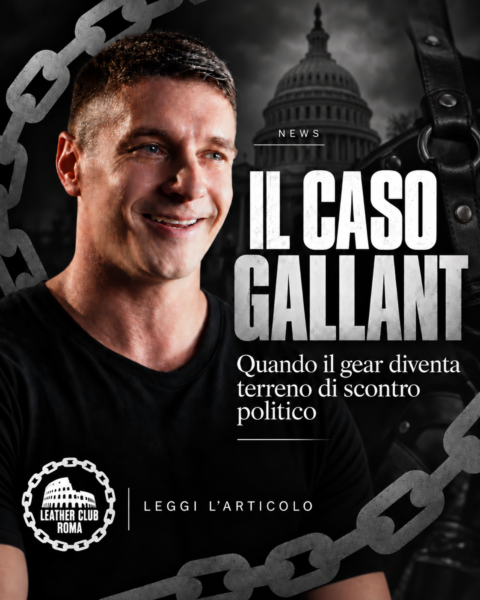
There is a moment in the life of every fetish and kinky person when one’s intimacy stops being a choice and becomes a weapon in someone else’s hands. It happened in New York, where the New York Post published photos from more than ten years ago showing Chris Gallant, now a Democratic candidate for Congress, as a model for Mr. S Leather, the historic fetish store in San Francisco. Gallant was serving in the National Guard when those photos were taken: a private, consensual shoot, shared with his then partner. Material that concerned only him, until someone decided it concerned everyone — with the sole aim of sinking him.
It did not sink him. Gallant replied without backing down an inch, calling the operation a coordinated political attack and claiming the right not to be ashamed of who he is. And here, for us at LCR, the story stops being American news and becomes something much closer to home.
It’s not the first time, and it won’t be the last
 Anyone who lives fetish and kinky culture knows this script by heart. You don’t need a run for Congress: a photo on a social profile, a video, a rumour going round the office is enough. The mechanism is always the same — turning a conscious expression of one’s sexuality into a guilt to be publicly atoned for. It is the hypocrisy of “do it but don’t say it” that we have denounced since we existed: silent tolerance for what stays hidden, immediate punishment for what dares to show itself.
You don’t even need to look at America. In these same days, in Rochdale, in the north of England, it was enough for two people to create a Grindr account on purpose to find the profile of Paul O’Neill, Labour councillor for North Heywood, capture screenshots and spread them on Facebook accompanied by calls to resign because — they said — “a public figure should be more discreet about their private life“. Among the images that circulated, needless to say, stood out a photo in a leather harness, taken at Manchester Pride. O’Neill did not apologise: he replied with irony, restating that he feels no shame about his social and love life, and received in return the support of residents, activists and fellow councillors of every party. The same script as Gallant, the same weapon — gear made public against one’s will — and, fortunately, the same refusal to bow to shame imposed by others.
The Gallant case works as a litmus test because it brings to light, on an international scale and with all the brutality of politics, a mechanism we face every day on our small scale: the one by which kinky identity is treated as a shameful secret, good at most for gossip or a sensationalist headline, never for a dignified narrative.
“Gear Up. Play Proud. Stand Out.” — it’s not just a slogan
In our Political Manifesto of the fetish and kinky community, published and renewed for Pride Month, we write that our presence at Pride, in public spaces, in civic life is a deeply political act. We write it together with the slogan Gear Up. Play Proud. Stand Out. — three imperatives that today, looking at New York and Rochdale, are confirmed not as a banner motto but as an almost literal description of what Gallant and O’Neill did: they showed themselves in their gear, they lived their desire with pride instead of shame, they refused to disappear.
And our manifesto says it clearly: our community does not ask for permission, it self-determines. And that is exactly what a candidate for Congress and a Labour councillor demonstrated, under the spotlight of the whole press, when they chose to answer the attack by claiming themselves instead of disowning themselves.
There is then a second principle of our political document that returns here with force: depathologisation. For over a decade paraphilias have no longer appeared among mental disorders in the international diagnostic manuals, yet the public narrative — that of some of the press, but often also the implicit one of certain “respectable” circles — continues to treat those who live fetish as someone to be justified, cured, hidden. The attempt to derail a political candidacy with photographs of leather and harnesses is the clearest proof that this cultural battle is far from won.
Why associative activism is crucial
It is easy, from the outside, to think that a leather club only organises parties, themed weekends, Mister Leather elections. Those who live in our community know this is not so, and the Gallant case explains it better than any press release: without organised networks, without associations that take on the political responsibility of speaking on behalf of an entire culture, every single fetish person is left alone at the moment someone decides to weaponise their identity against them.
That is why for twenty-five years LCR has not limited itself to organising events, but writes political documents, dialogues with the other realities of the movement, and claims a full place — not a footnote — within the LGBTQIAPK+ community. An association like ours exists also for this: to be the intermediary body that turns individual vulnerability — that of any Chris Gallant or Paul O’Neill, who could be any one of us — into a collective voice that is hard to ignore. Alone, you are blackmailed with a photograph. Together, you write a manifesto, organise a Pride, build a culture that no longer needs to apologise for existing.
Community care is a response to stigma and isolation — not an abstraction, but something that shows in concrete welcome, in listening networks, in the choice to be present in public spaces instead of retreating into protected ones. The firm rejection of kink-shaming and role-shaming that we claim in our spaces is not a luxury internal to the community: it is the antibody we must build, all together, against exactly the kind of attack Gallant suffered.
No one should discover themselves alone on the day their private life becomes a newspaper headline. And it is precisely the task of realities like LCR — and of all the sister associations of the ECMC network — to make sure that, if that day comes, it finds no one unprepared or isolated.
Every time someone tries to turn gear into a guilt, the most effective answer is not silence: it is the multiplication of voices that refuse to be ashamed. This is why our events, our nights, our weekends around Italy exist — Rome, Palermo, and the many groups that share our path — not mere occasions for partying, but the daily construction of that community which, on the day of need, becomes a network, support, a collective voice.
The question, then, is not whether the next Gallant case will come — it will, in one form or another, perhaps much closer than we think. The question is whether, when it comes, it will find us organised or scattered.
In this, the participation of each of us – not only as a guest, but also and above all as an activist – is the crucial element of the response: Gear up. Play proud. Stand out can be more than a slogan and become the engine of a fight against discrimination that, especially in the increasingly adverse and hostile times we live in, we can no longer think of delegating. We must win it together.